


Former president Ma Ying-jeou (馬英九) is to attend an awards ceremony for Asian journalists in Hong Kong later this month — his first trip abroad since leaving office on May 20.
In an announcement issued yesterday, Ma’s office said the former head of state is due to attend the Society of Publishers in Asia Awards (SOPA) for Editorial Excellence ceremony to be held at the Hong Kong Convention and Exhibition Centre on June 15, with Ma scheduled to give a speech in English on cross-strait relations and the situation in East Asia.
“The SOPA in January issued an invitation for Ma to be the keynote speaker for the awards event through a local publication, Commonwealth Magazine, whose founder and chairwoman Diane Ying (殷允芃) invited Ma again in person during an economic forum held by the magazine in Taipei on Jan. 21,” Ma’s office said.
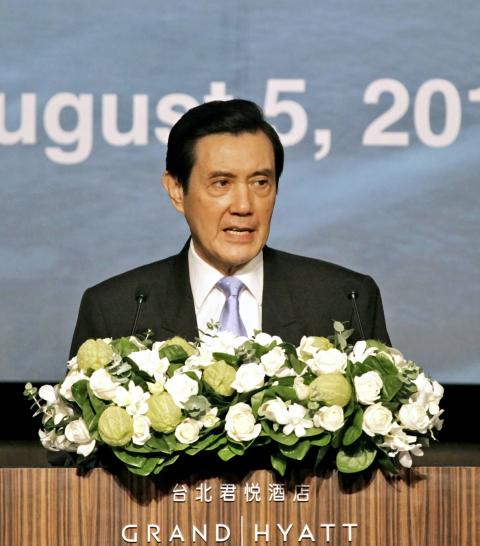
Photo: David Chang, EPA
Established in 1982, the society is a non-profit organization based in Hong Kong that is dedicated to safeguarding freedom of the press, Ma’s office said, adding that the ceremony is a widely anticipated annual event held to recognize outstanding performances among journalists from Asian countries.
“Nevertheless, to prevent people with a vested interest from making a big fuss over the matter, Ma’s visit to Hong Kong is only to be a one-day trip. It will be transparent throughout the process and we welcome journalists to come along,” the office said.
According to a news release issued yesterday by the society, Ma is scheduled to share his thoughts on cross-strait ties, the significance of his meeting with Chinese President Xi Jinping (習近平) in Singapore in November last year and territorial disputes in the South China Sea.
The Ma-Xi meeting was the first meeting between leaders from both sides of the Taiwan Strait since the end of the Chinese Civil War in 1949, which has been touted by Ma as the proof of his cross-strait rapprochement policy’s success.
Presidential Office spokesman Alex Huang (黃重諺) said the relevant application documents from Ma arrived at the office yesterday morning and that they would be processed in accordance with the Classified National Security Information Protection Act (國家機密保護法).
Under Article 26 of the act, people who exercise the original classification authority, handle classified information within the scope of their official duty, retire or resign from the official positions mentioned in the act or have handled the transfer of classified information within three years should obtain prior approval before leaving the nation.
However, Democratic Progressive Party Legislator Wang Ting-yu (王定宇) said Ma is required by Article 32 of the Enforcement Rules of the Classified National Security Information Protection Act (國家機密保護法施行細則) to file a written application 20 days prior to his planned departure.
“I must warn Ma’s office that the former president has once again disregarded the law and the interest attached to the nation’s classified information,” Wang said.
“I should also remind the Presidential Office that … since it only received the application documents this morning, there is just one decision it can make — turn down Ma’s application,” he said.

‘NO SECURITY RISK’: The Railway Bureau reassured the public that the technicians’ activities were limited to technical guidance and did not involve sensitive systems The Railway Bureau yesterday said it had invited eight Chinese technicians to assist with an airport MRT construction project. The bureau issued the confirmation after an Internet user said Chinese nationals had entered the construction zone of Taiwan Taoyuan International Airport’s Terminal 3 project. They asked why “individuals from an enemy state” were allowed access to such a major national infrastructure project, which raised serious concerns over Taiwan’s industrial safety, sensitive systems and information security. The bureau’s Northern Region Engineering Branch Office said subcontractor Taiwan Handle Industrial Co (台灣手把工業) of the Taoyuan airport MRT’s “Contract No. CU05 Project A14 Station Civil, MEP &

A US uncrewed surface vessel (USV) encountered multiple Chinese warships during an autonomous transit of the Taiwan Strait, US defense company Seasats said in a statement on Wednesday. Seasats announced that a Lightfish USV had completed the first autonomous transit of the Taiwan Strait. Over five days, the USV traversed the entire length of the Strait while constantly monitoring surface vessel traffic, the company said. The Lightfish encountered multiple Chinese warships, one of which was a Chinese People’s Liberation Army Navy (PLAN) Type 056 corvette, it said. The Chinese vessels were operating “well within Taiwan’s exclusive economic zone without transmitting their identity via the
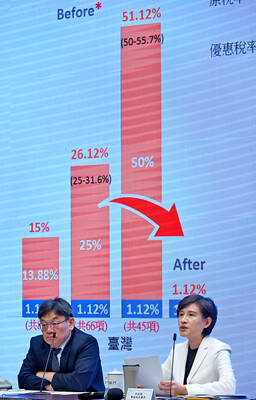
GREATER REACH? Auto parts and wood products would face tariffs of up to 15%, matching those targeting the EU, Japan and South Korea, Vice Premier said The US has announced that preferential tariff treatment for Taiwan’s non-semiconductor Section 232 goods would take effect retroactively from May 1, the Executive Yuan said yesterday. The US government yesterday posted a notice on the Federal Register’s public inspection Web site previewing tariff concessions for Taiwan under a memorandum of understanding (MOU) on Taiwan-US investment after two months of negotiations. The MOU signed on Jan. 15 stipulated three major preferential tariff arrangements: a 15 percent “reciprocal” tariff rate for Taiwan without stacking most-favored nation (MFN) rates; preferential Section 232 treatment for semiconductors and related products; and preferential Section 232 treatment for non-semiconductor

The National Chungshan Institute of Science and Technology yesterday showcased its locally developed variants of the Vision 60 robotic patrol dog, which it plans to deploy on the nation’s outlying territories in the South China Sea. The variants were produced under the Joint Lab project — created by the institute and domestic companies — and assembled with domestically produced motors, lenses and artificial intelligence (AI) systems alongside licensed tech from the US, Missile and Rocket Systems Research Division deputy director Jen Kuo-kang (任國光) told the media event at a military base in Taipei’s Dazhi (大直) area. Taiwan has built up its strengths


 RSS
RSS